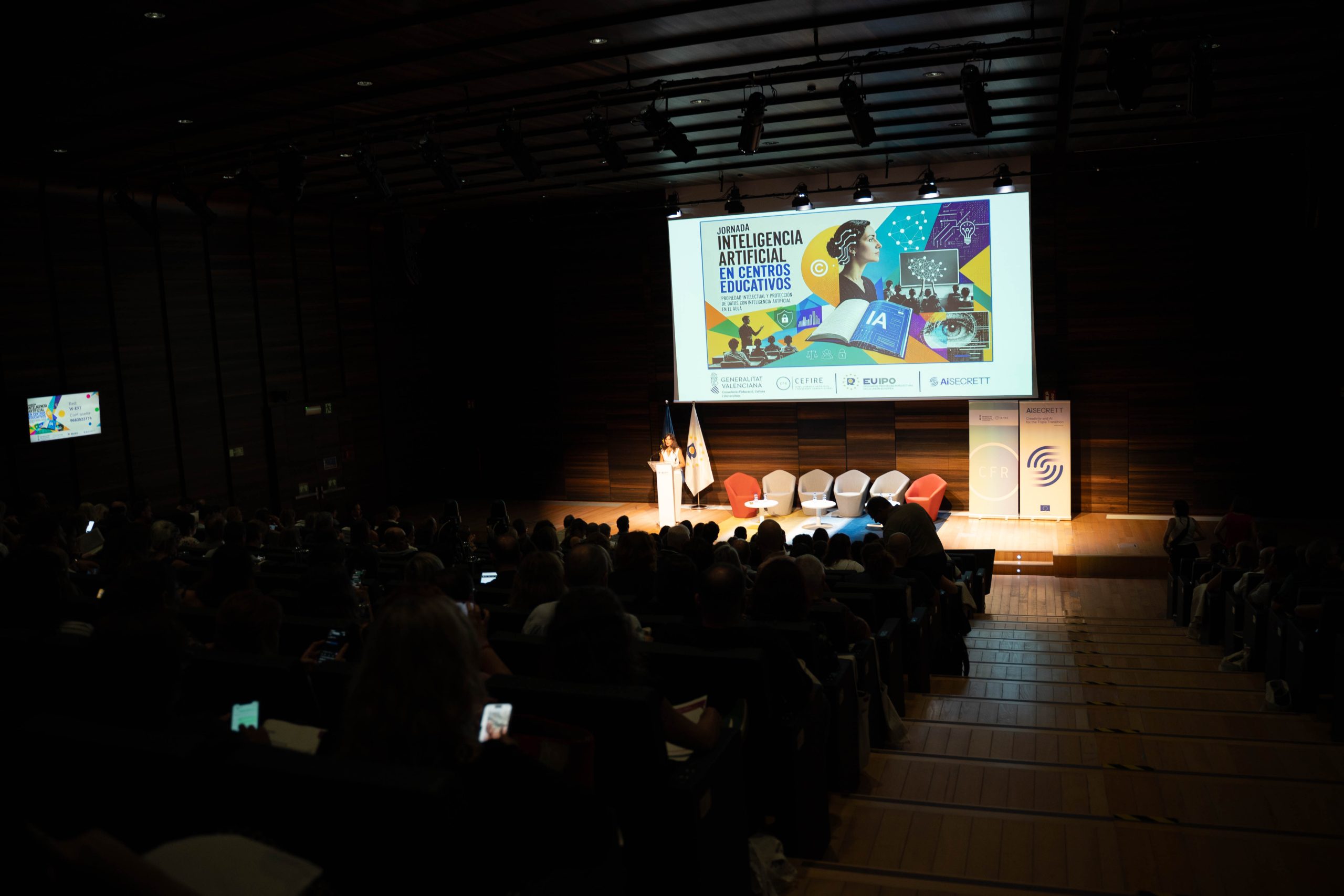
On 30 September, 450 participants, school leaders and experts gathered at the headquarters of the European Union Intellectual Property Office (EUIPO) in Alicante for the Jornada de Inteligencia Artificial en Centros Educativos.
Jointly organised by the CEFIRE for Artificial Intelligence and Computational Thinking and EUIPO, the event created a valuable space to examine how artificial intelligence is entering education and what schools need to ensure that its adoption is responsible, informed and centred on people.
The opening contributions from Nuria Oliver and Diego Miguel Lozano, from the ELLIS Alicante Foundation, invited participants to look beyond the capabilities of individual technologies. Their interventions explored the impact of AI on cognitive processes and student autonomy, placing ethical responsibility at the heart of its use in the classroom. The discussion raised an essential question for the education community: not only what AI can do, but how its use may affect the way students learn, think and develop.
The programme also addressed one of the main concerns currently facing educators: how to use generative AI while protecting personal data, privacy, intellectual property and authors’ rights. Contributions from Rosabel Roig Vila, Lydia Esteve, Diego Miguel Lozano and Joaquín Cañada brought the European AI Act, data protection requirements and intellectual property considerations into a practical educational context.
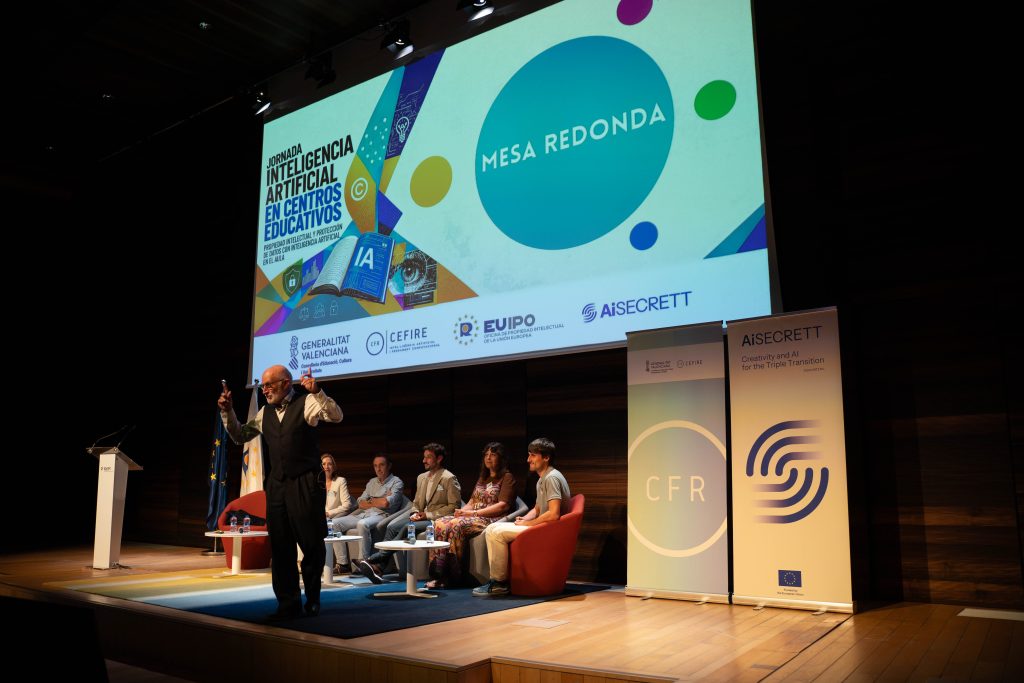
These sessions connected the regulatory framework with real decisions made by teachers and school leaders, including the responsible creation of learning materials with generative AI. A multidisciplinary roundtable moderated by Manuel Desantes brought together legal, technological and educational perspectives. The contribution of Raúl Solbes added the viewpoint of educational leadership and inspection, helping to connect regulation with school management and everyday classroom practice.
Beyond the formal sessions, the event included a dedicated networking space where teachers, management teams and participating organisations could exchange experiences and establish new connections. These conversations helped lay the groundwork for future collaboration between educational centres and for the follow-up training programme linked to the event.
AI-SECRETT partner CECU was represented by Miguel Ángel Lafuente, Salvador Mira and Maria José Lozano. Their participation connected the project with a practical example of the skills, institutional collaboration and responsible decision-making needed to navigate the digital transition.

The programme extends beyond the in-person conference through six hours of asynchronous online training and will conclude on 15 October. The strong attendance in Alicante highlights the importance of understanding AI from a broader perspective: one that combines innovation with ethics, digital skills, legal awareness, privacy and intellectual property rights.
For AI-SECRETT, initiatives such as this one show why the digital transition must be accompanied by social responsibility, institutional capacity and opportunities for professionals to learn together.
Learn more about the programme: Jornada de Inteligencia Artificial en Centros Educativos